Do you need to identify grasses and/or sedges to species, or have an interest in learning how?
Then these courses are for you!
Astrebla Ecology offers the only public Poaceae and Cyperaceae ID workshops available in Australia that are based on hands-on ID using a microscope & keys.
Each workshop provides a 2-day intensive study of either Poaceae or Cyperaceae & offers a more comprehensive coverage of either family than you can get at any Australian university.
The workshops have a northern Australian focus but the skills & knowledge gained will be directly transferable to Poaceae or Cyperaceae ID anywhere in Australia.
And no matter your level of previous ID experience, you will learn a lot from these workshops. All material presented in the workshops is ruthlessly practical &directed towards what the field botanist/ecologist needs to know to negotiate Poaceae &Cyperaceae keys. It has been developed for professional ecologists and botanists with existing skills in botanical keying and with a tertiary education, or for people already at least partly confident in using botanical language and keys.
Workshops (both sedge & grass) can be booked via the Humanitix website: https://humanitix.com/au
Search for events using the keywords ‘Simon Danielsen’.
Public workshops are held periodically at The Hut, 47 Fleming Rd, Chapel Hill, Brisbane.
Alternatively, if you can book 5 or more attendees at your workplace, in-house workshops can also be arranged.
At the completion of the Grass workshop, you will:
- Be familiar with the more common grass genera of northern Australia & the morphological concepts underpinning their ID (primarily C4 grasses).
- Be able to recognise spikelet & inflorescence features & interpret the botanical language used to describe them.
- Be able to find those features in grasses you examine in the field using a hand lens.
- Be able to negotiate digital and dichotomous keys with more confidence and accuracy (& greater speed). These skills are transferable to other families.
At the completion of the Sedge workshop, you will:
- Be familiar with the keys to species of most of the most common genera of sedges in northern Australia: Cyperus, Fimbristylis, Scleria, Schoenus, Eleocharis and Carex.
- Be familiar with the main concepts used in the Cyperaceae family key, with practice in keying out genera such as Bulbostylis, Bolboschoenus, Carex, Cyperus, Eleocharis, Ficinia, Fimbristylis, Fuirena, Lepidosperma, Lepironia, Rhynchospora, Schoenoplectiella, Schoenoplectus, Schoenus, Scleria and Trachystylis.
- Be able to distinguish between members of the Cyperaceae family and those of superficially similar families such as Restionaceae & Juncaceae.
- Be able to negotiate dichotomous keys with more confidence and accuracy (and greater speed). These skills are transferable to other families.
Most importantly, you will have built confidence and a solid foundation on which to continue a lifetime of independent learning in grass/sedge identification & botany.
This is a unique opportunity to learn these ID and microscope dissection skills from an ecologist with more than 20 years’ experience, in a relaxed and supportive environment.
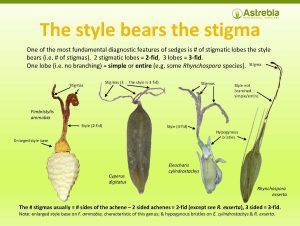
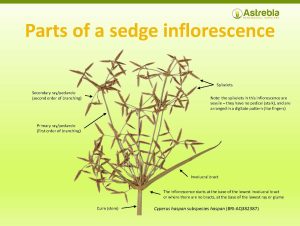
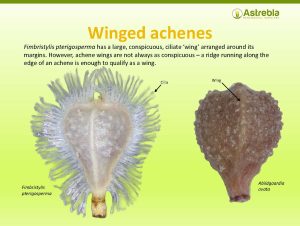
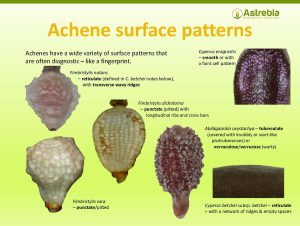
The course notes (see examples below) provide clear ID pointers using microscope images that will assist you in your ID endeavours for years to come!
Workshop details:
- Workshop cost covers a 2 day workshop (either grass or sedge) (8 am – 5 pm) – check latest price on the Humanitix website (search keyword ‘Simon Danielsen’).
- You will need to take a laptop (or you can use your phone) so that you can view the digital course notes and keys.
- Course format is simple – a presentation followed by a hands-on session with microscopes and samples of the target genera/tribe. Each student will have their own microscope.
- Class size is limited to 10 students.
- Lunch (vegetarian and non-vegetarian sandwiches), snacks and morning/afternoon tea will be provided.
- Each participant will be provided with detailed digital course notes including microscope photographs illustrating key features of the family and genera covered (see below).
- In addition, each participant will receive to keep:
- a pair of forceps for dissecting spikelets,
- a pocket metal ruler ideal for use in field IDs.
Contact Simon at simon@astrebla.com or on 0423 706 440 for further information

These courses are conducted by Simon Danielsen, a field botanist & ecological consultant with over 20 years’ experience in botanical field surveys & identifications across northern Australia.
Simon has run his own ecological consultancy operation (Astrebla Ecological Services) since 2015 & is highly experienced in vegetation mapping, threatened plant surveys & the field identification of grasses & other plants. In 2014, he spent a year in the ID room at the Bangkok Forestry Herbarium in Thailand, completing over 400 botanical determinations in that time.
Examples of the course presentation slides are provided below: